- All
- Product Name
- Product Keyword
- Product Model
- Product Summary
- Product Description
- Multi Field Search

Views: 0 Author: Site Editor Publish Time: 2026-05-12 Origin: Site


The inquiry into the quantity of servings within a standard liquor bottle, colloquially known as a "fifth," reveals a confluence of historical convention, metrication policy, and industry standards. This analysis examines the transition of the "fifth" from its historical definition as one-fifth of a U.S. gallon to its modern, legally defined volume of 750 milliliters. The number of shots derivable from this volume is not a fixed integer but a variable contingent upon the definition of a "shot," which fluctuates geographically and contextually. By calculating the yield based on the prevalent U.S. standard of 1.5 fluid ounces (approximately 44.36 milliliters), this document establishes a baseline figure. It further investigates how deviations in pour size, pouring techniques, and international standards alter this yield. The economic implications for commercial establishments, particularly regarding inventory control and profitability analysis, are explored. The discussion also extends to the role of bottle design in consumer perception, demonstrating how the physical container influences the experience of its contents.
A standard 750ml bottle, known as a fifth, contains approximately 17 standard 1.5-ounce shots.
The term "fifth" originates from its old volume of one-fifth of a U.S. gallon.
Knowing how many shots are in a 5th is fundamental for accurate bar inventory and cost management.
Shot sizes vary globally, which changes the total number of servings per 750ml bottle.
Precise pouring with a jigger maximizes the number of shots and ensures service consistency.
Bottle ergonomics and design can influence pouring accuracy and perceived value.
The Professional Application: Why This Calculation Governs Bar Profitability
A Global Perspective: Shot and Bottle Sizes Around the World
The Vessel Itself: How Bottle Design Intersects with Volume and Value
To approach the question of how many shots are in a 5th, one must first engage in a form of historical archaeology. The term "fifth" itself feels like a relic from a different era, a ghost in our modern machine of standardized metric units. Why do we cling to this particular piece of nomenclature? The answer lies in the United States' unique journey toward metrication, especially within the context of distilled spirits. The term is not arbitrary; it is a direct reference to a specific, now-obsolete measurement: one-fifth of a U.S. liquid gallon.
A U.S. gallon is defined as 128 U.S. fluid ounces. A simple division (128 / 5) yields 25.6 U.S. fluid ounces. For many decades, this was the standard size of a primary liquor bottle. It was the container that consumers knew, the volume that bartenders used for their calculations. It represented a familiar quantity, a unit of trust between producer and consumer. This system, however, existed within a larger global context that was increasingly moving toward the streamlined logic of the metric system.
The landscape of liquor bottling in the United States underwent a seismic shift in the late 1970s. The Alcohol and Tobacco Tax and Trade Bureau (TTB), the governing federal body, mandated a conversion to metric sizes for wine and distilled spirits. This policy, which took full effect on January 1, 1980, aimed to standardize container sizes, simplify international trade, and align the U.S. with global norms (GPO, 1976). The old imperial measurements were retired, replaced by a new set of approved metric volumes.
The half-gallon was replaced by the 1.75-liter bottle (often called a "handle"). The quart was replaced by the 1-liter bottle. The fifth, that cornerstone of the American bar, was replaced by the 750-milliliter bottle.
Think for a moment about the challenge this presented. The regulators needed to choose a metric equivalent that was close enough to the original "fifth" to avoid significant disruption to consumers' expectations and industry production lines. How close did they get?
The Old Fifth: 25.6 U.S. fluid ounces
The New "Fifth" (750 ml): Approximately 25.36 U.S. fluid ounces
The difference is a mere 0.24 fluid ounces, a negligible amount for the average consumer. The 750 ml bottle was a near-perfect substitute, allowing the industry to adopt the new standard while consumers could continue, colloquially, to ask for a "fifth." The name stuck, a testament to linguistic inertia and cultural memory, even as the technical definition of the container it described had changed forever.
The transition created a new vocabulary for bottle sizes. Understanding both the old and new terminology is helpful for appreciating the context of liquor volumes.
| Common Name | Old U.S. Imperial Size | Modern Metric Equivalent | Volume (ml) |
|---|---|---|---|
| Miniature / "Nip" | 1.6 fl oz (approx.) | 50 ml | 50 |
| Half Pint | 8 fl oz | 200 ml | 200 |
| Pint | 16 fl oz | 375 ml (often called a "pint") | 375 |
| Fifth | 25.6 fl oz | 750 ml (standard bottle) | 750 |
| Quart | 32 fl oz | 1 L (liter) | 1,000 |
| Half Gallon | 64 fl oz | 1.75 L ("handle") | 1,750 |
This table illustrates the methodical replacement of an imperial system with a metric one. The legacy names, however, often persist, creating a hybrid language spoken in bars and liquor stores across the nation.
Having established that a modern "fifth" is a 750ml bottle, we can now address the core question. The answer is a function of simple division, but it hinges entirely on a second, equally important definition: the volume of a "shot."
Unlike the bottle size, which is federally mandated, the size of a shot is not legally defined at a national level in the United States. It is a standard of practice, a convention adopted by the hospitality industry for consistency and portion control.
In the United States, the overwhelmingly accepted standard for a single shot of liquor is 1.5 U.S. fluid ounces. This is the amount you will find in most bar-service training manuals, the volume for which most single-shot jiggers are calibrated, and the quantity assumed by the National Institute on Alcohol Abuse and Alcoholism (NIAAA) when defining a "standard drink" containing spirits (NIAAA, 2021).
To perform our calculation, we must first convert all our units to a common measurement. Since the bottle is measured in milliliters, let us convert the shot size to milliliters as well.
1 U.S. Fluid Ounce = 29.5735 milliliters
Therefore, a standard 1.5 fl oz shot is:
1.5 fl oz * 29.5735 ml/fl oz = 44.36 ml
Now, the calculation becomes straightforward. We divide the total volume of the bottle by the volume of a single shot:
750 ml (bottle volume) / 44.36 ml (shot volume) = 16.907 shots
For all practical purposes, this number is rounded to the nearest whole number. So, the definitive answer to how many shots are in a 5th is 17.
You can expect to get 17 full 1.5-ounce pours from a standard 750ml bottle of liquor. This is the foundational number for any further analysis.
While 1.5 ounces is the standard, it is not the only pour size you will encounter. Some establishments may use different measurements for various reasons, such as creating "short" pours for tasting flights, "long" pours for premium offerings, or simply following a different house standard. Each variation directly impacts the total yield from a bottle.
Let us explore how the number of shots changes with different pour sizes.
| Shot Size (fl oz) | Shot Size (ml) | Number of Shots per 750ml Bottle (Approx.) | Common Use Case |
|---|---|---|---|
| 1.0 oz | 29.57 ml | 25.3 shots | Tasting flights, mixed drinks with multiple spirits |
| 1.25 oz | 36.97 ml | 20.2 shots | Some bar standards for cost control |
| 1.5 oz | 44.36 ml | 16.9 shots (Standard) | U.S. industry standard for a single pour |
| 2.0 oz | 59.15 ml | 12.6 shots | "Double" or "rocks" pour, premium cocktails |
This table reveals a critical principle: the relationship between pour size and bottle yield is inversely proportional. A decrease in the pour size by just half an ounce (from 1.5 oz to 1.0 oz) increases the bottle's yield by over eight shots. Conversely, serving a 2-ounce "double" reduces the yield by more than four shots. This mathematical reality is the bedrock of bar economics. Understanding how many shots are in a 5th is not just trivia; it is a financial imperative.
The calculation of 17 shots per 750ml bottle exists in a perfect, theoretical world. In the reality of a busy bar or a home cocktail party, several factors can conspire to reduce that yield. The difference between a theoretical yield and an actual yield is known as variance, and minimizing it is a key goal for any professional.
Imagine a seasoned bartender, confident and swift, upending a bottle and, with a flick of the wrist, stopping the flow of liquid at what looks like the perfect level in the glass. This is "free-pouring." It is theatrical, fast, and often impresses customers. However, it is also notoriously inaccurate. Even with extensive training, a free-pour can easily be off by a quarter-ounce or more in either direction (Barth, 2013).
Let's consider the financial impact. If a bartender consistently over-pours by just 0.25 ounces on a standard 1.5-ounce shot, they are pouring 1.75 ounces.
750 ml / (1.75 fl oz * 29.5735 ml/fl oz) = 750 ml / 51.75 ml = 14.49 shots
That small, seemingly insignificant over-pour has just cost the establishment 2.5 shots per bottle. Across dozens of bottles per week, the financial losses accumulate rapidly.
The alternative is using a jigger. A jigger is a small, hourglass-shaped measuring tool used by bartenders to ensure an exact pour every time. While it may add a second or two to the process of making a drink, it eliminates the guesswork. Using a jigger is the single most effective way to ensure you get your full 17 shots from every fifth. It transforms the question from an estimate into a reliable fact.
Every time a bottle is opened, there is a potential for loss. A shaky hand might cause a small spill. A drop or two might cling to the rim of the bottle after a pour. When a bottle is nearly empty, it can be difficult to extract the final few milliliters without wasting time or liquid. This collective, minor loss is often referred to as "shrinkage."
While a single drop of whiskey is inconsequential, over the life of a bottle, these small losses add up. A well-run bar will train its staff on efficient pouring techniques to minimize this waste. This includes:
Using a pour spout for a clean, controlled stream.
Holding the bottle and glass over the bar mat or ice well to catch any spills.
Combining the remnants of nearly empty bottles of the same spirit (a practice known as "marrying," though its legality can vary by jurisdiction).
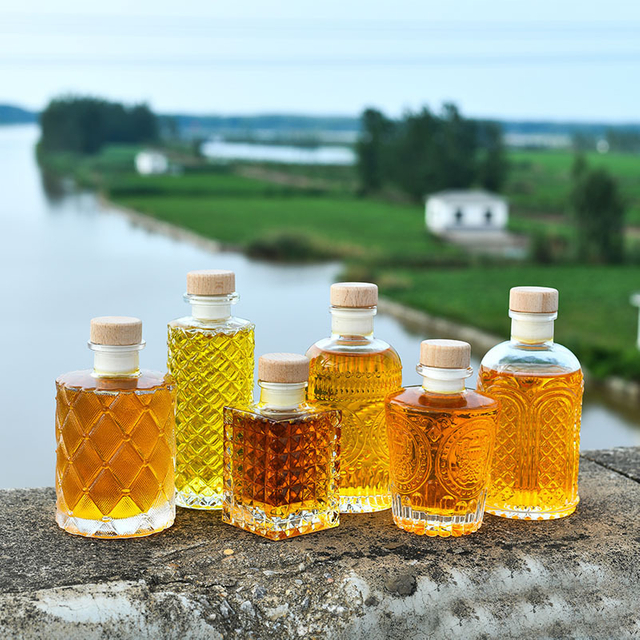
The design of the bottle itself also plays a role. A bottle with a long, narrow neck might be easier to control than one with a short, wide opening. The weight and balance of the glass can affect the bartender's comfort and stability. These are subtle but meaningful aspects of ergonomic design that manufacturers of premium glass spirit bottles consider. A well-designed bottle is not just a container; it is a tool for the bartender.
The way the spirit is served also influences the perceived volume and the actual pour.
Neat Pour: A spirit served neat (at room temperature, in a glass) is the most straightforward. The 1.5 ounces are poured directly into the glass.
On the Rocks: When a spirit is served over ice, the pour size might be adjusted. Some bars will pour a slightly larger amount, perhaps 2 ounces, to account for the dilution that will occur as the ice melts. The ice also displaces volume in the glass, making a standard 1.5-ounce pour appear less substantial.
Cocktails: In a mixed drink, the 1.5-ounce measure is often the base. However, complex recipes may call for smaller amounts of multiple spirits. For example, a drink might require 1.5 ounces of vodka, 0.5 ounces of a liqueur, and 0.25 ounces of an amaro. In these cases, knowing the shot count for each bottle is essential for accurately costing the entire cocktail.
The question of how many shots are in a 5th becomes a starting point for a more complex series of calculations when building a cocktail menu.
For a bar or restaurant owner, the number 17 is not just a piece of trivia. It is one of the most fundamental metrics for determining the financial health of their business. The entire pricing structure of a beverage program is built upon this simple division.
Pour cost is a percentage that represents the portion of a drink's sale price that is consumed by the cost of the ingredients. A lower pour cost generally means higher profitability. The formula is:
Pour Cost % = (Cost of Ingredients / Sale Price) * 100
To find the cost of your primary ingredient (the spirit), you must first know your cost per shot.
Cost per Shot = (Cost of Bottle / Number of Shots per Bottle)
Let's walk through an example. Suppose you purchase a 750ml bottle of bourbon for $25. You know, with disciplined use of a jigger, you will get 17 shots from it.
Cost per Shot = $25 / 17 shots = $1.47 per shot
Now, you can price your drink. A common target pour cost for primary spirits is around 20%. To find the ideal sale price for a neat pour of this bourbon, you can rearrange the pour cost formula:
Sale Price = Cost of Ingredients / Target Pour Cost %
Sale Price = $1.47 / 0.20 = $7.35
You would likely round this up to a standard menu price, perhaps $7.50 or $8.00. This entire process, from purchasing to pricing, is impossible to perform accurately without first answering the question of how many shots are in a 5th.
Bars conduct regular inventory to track their stock and identify potential problems. The process typically involves counting the number of full bottles and estimating the contents of open bottles. This physical count is then compared to the theoretical amount of liquor that should have been used, based on sales data from the point-of-sale (POS) system.
For example, if the POS shows you sold 30 shots of a particular vodka, you should have used approximately 1.76 bottles (30 / 17). If your physical inventory count shows that 2.5 bottles are gone, you have a variance. That missing 0.74 of a bottle represents lost profit due to over-pouring, spillage, or even theft.
Accurate tracking relies on a consistent and known shot count per bottle. It allows managers to spot issues quickly, retrain staff on proper pouring techniques, and maintain control over their most valuable liquid assets.
While the 750ml bottle is a near-global standard, the definition of a "shot" is far more fluid. Traveling from one country to another can be a disorienting experience for those accustomed to a specific pour size. This variation is a product of cultural norms, government regulations, and historical precedent.
Let's examine the standard pour sizes in several key markets.
United Kingdom: In the UK, spirit measures are regulated by the Weights and Measures Act. Pubs and bars can serve single measures of either 25ml or 35ml, but they must clearly state which one they are using. The 25ml pour is more common.
Germany: The standard shot size, known as a "schnaps," is typically just 20ml. This smaller size reflects a different cultural approach to spirit consumption.
Australia: A standard shot is 30ml. They also have a smaller 15ml pour, often used in cocktails.
Japan: A single pour is often 30ml, similar to Australia. However, the culture of precision and ritual in Japanese bartending means this measure is adhered to with exceptional rigor.
South Africa: The legal single-spirit serving size is 25ml (Department of Trade and Industry, 2014).
The impact of these variations on the yield from a standard 750ml bottle is significant. A bar manager in London gets a vastly different number of servings from a bottle of gin than their counterpart in New York.
Let's revisit our table, this time from an international perspective:
| Country/Region | Standard Shot Size (ml) | Number of Shots per 750ml Bottle (Approx.) |
|---|---|---|
| Germany | 20 ml | 37.5 shots |
| United Kingdom / South Africa | 25 ml | 30 shots |
| Australia / Japan | 30 ml | 25 shots |
| United States / Canada | 44.36 ml (1.5 fl oz) | 16.9 shots |
The data is striking. A German bar owner gets more than double the number of servings from the exact same 750ml bottle as an American bar owner. This highlights how profoundly local customs and regulations can alter the economic equation of selling spirits. It also underscores that the answer to how many shots are in a 5th is not universal; it is geographically dependent.
Throughout this discussion, we have treated the 750ml bottle as a simple container of a fixed volume. But the bottle is so much more. It is the first point of contact between the consumer and the spirit. It is a marketing tool, a statement of brand identity, and an object that conveys quality (or a lack thereof). The choices made in the design of a glass bottle have a profound psychological impact that operates independently of the liquid inside.
Think about the last time you browsed the aisles of a liquor store. What made you pick up one bottle over another? It likely had to do with the physical characteristics of the glass.
Weight and Base: A bottle with a heavy, thick glass base—often called a "heavy-base" bottle—feels more substantial and luxurious in the hand. It suggests a premium, high-quality product, even though the internal volume is still exactly 750ml. This is a common design choice for high-end whiskeys, vodkas, and tequilas.
Shape: The silhouette of a bottle can create instant brand recognition. Consider the square shape of a Jack Daniel's bottle or the distinct, long-necked profile of a Belvedere vodka bottle. These shapes become iconic, communicating the brand's story before a single drop is poured. Custom bottle shapes allow new brands to carve out a unique visual space on a crowded shelf.
Color: Clear "flint" glass showcases the color of the spirit itself, ideal for vodkas, gins, and white rums. Amber or green glass, common for beers and some spirits, provides UV protection, which can help preserve the integrity of the contents over time (Verghese et al., 2021). The color of the glass sets an immediate expectation about the product.
The Punt: The indentation at the bottom of many wine and some spirit bottles is called a punt. While it has historical origins related to glassblowing, today its depth is largely an aesthetic choice. A deep punt can add to the premium feel of a bottle, making it appear larger and more impressive.
These design elements do not change the answer to how many shots are in a 5th. The volume remains 750ml. What they do change is the perceived value of each of those 17 shots. A spirit poured from an elegant, custom-designed bottle feels more special than one from a generic stock bottle. This perceived value allows brands to command higher prices, directly impacting the profitability calculated earlier. The bottle is not just packaging; it is an integral part of the product experience.
1. Is a "fifth" exactly the same as a 750ml bottle? Not exactly, but they are functionally equivalent. A historical "fifth" was one-fifth of a U.S. gallon, or 25.6 fluid ounces. A modern 750ml bottle is 25.36 fluid ounces. The term "fifth" has persisted as the common name for the 750ml bottle because the volumes are so close.
2. How many total fluid ounces are in a fifth (750ml bottle)? A 750ml bottle contains approximately 25.36 U.S. fluid ounces. This is calculated by dividing 750ml by 29.5735 (the number of milliliters in one U.S. fluid ounce).
3. Why is it called a "fifth" if it's not a fifth of a gallon anymore? The name is a holdover from the pre-metrication era in the United States. Before 1980, the standard bottle size was indeed one-fifth of a U.S. gallon. When the industry switched to the 750ml standard, the name stuck due to cultural habit, even though the measurement is now metric.
4. Does the type of liquor (vodka, whiskey, etc.) change the number of shots? No. The volume of the bottle is 750ml regardless of the spirit inside. As long as you are using a consistent shot size (e.g., 1.5 ounces), you will get the same number of shots from a bottle of vodka as you will from a bottle of whiskey.
5. How many 1-ounce shots are in a fifth? Using a 1-ounce pour (approximately 29.57ml), you can get about 25 shots from a 750ml bottle (750 / 29.57 ≈ 25.3).
6. What is the most accurate way to pour a shot? The most accurate and consistent method is to use a jigger. Free-pouring, even by experienced bartenders, often leads to inaccurate measures, which can result in lost profits for a business and inconsistent drinks for customers.
7. How many shots are in a "handle" (1.75L bottle)? A 1.75-liter bottle contains 1750ml. Using a standard 1.5-ounce (44.36ml) shot, you would get: 1750 ml / 44.36 ml ≈ 39.45 shots. So, you can expect to get about 39 shots from a handle.
The question of how many shots are in a 5th opens a door to a surprisingly rich world of history, mathematics, economics, and design. The simple answer, 17, is a product of a standard 750ml bottle and a standard 1.5-ounce pour. Yet, this number is not an immutable law. It is a baseline from which deviations occur based on pouring technique, waste, and international standards.
For the casual enthusiast, knowing this number provides a useful guide for hosting and mixing drinks. For the professional, it is the cornerstone of a profitable business. It informs every decision from pricing and inventory control to staff training and menu development. The variance between a theoretical yield of 17 shots and the actual number served is where profit is either secured or lost.
Furthermore, we see that the container itself, the glass bottle, is an active participant in this equation. Its design, from its weight to its shape, does not alter the volume but profoundly influences the perceived value of the shots within. It communicates a brand's ethos and can justify a premium price point, ultimately circling back to affect the financial calculations that began with our simple question. The journey from a fifth of a gallon to a 750ml vessel is more than a story about measurement; it is a story about how standards, culture, and commerce intersect in every single pour.
Barth, T. (2013). Speakeasy: The classic cocktails of the prohibition era, revisited. Sterling Epicure.
Department of Trade and Industry, South Africa. (2014). Liquor act 59 of 2003: Regulations. Government Gazette, 37763.
Government Publishing Office (GPO). (1976). Part 5—Labeling and advertising of distilled spirits. Code of Federal Regulations, Title 27, Volume 1.
National Institute on Alcohol Abuse and Alcoholism (NIAAA). (2021). What is a standard drink? National Institutes of Health.
Verghese, J., Nguyen, V., & Singh, S. P. (2021). Effects of colored glass bottles on the photo-degradation of vodka. Packaging Technology and Science, 34(6), 351–360. https://doi.org/10.1002/pts.2562